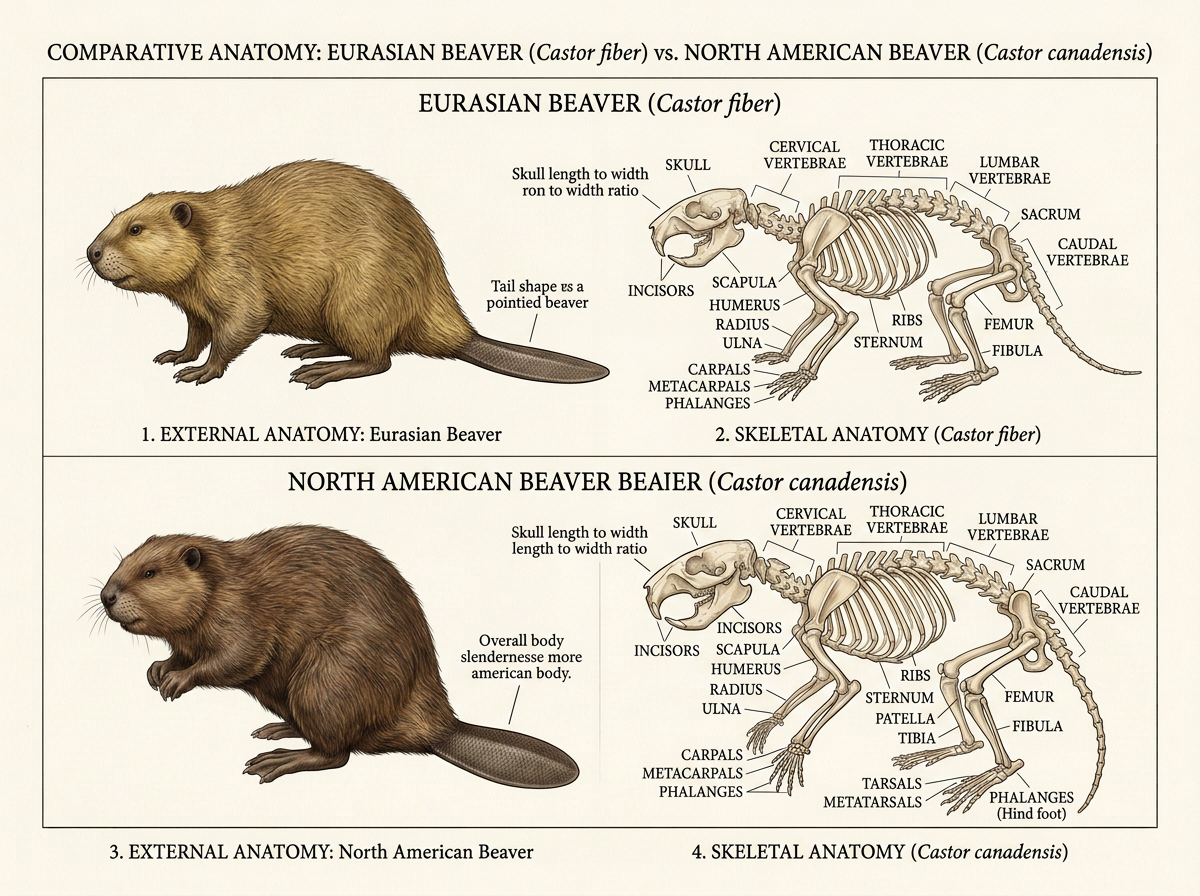
Beaver Anatomy - The Two Types of Beaver
There are two distinct living species of beaver in the world: the Eurasian beaver (Castor fiber)—which we host here in Clun—and the North American beaver (Castor canadensis).
Though physically similar, they are genetically distinct and cannot hybridize.
Both species possess extraordinary anatomical adaptations for an aquatic lifestyle, including dense waterproof fur, transparent third eyelids for swimming underwater, webbed hind feet, orange iron-reinforced teeth for gnawing wood, and a flattened, leathery tail used for steering and alarm slapping.
Key Adaptations & Differences:
- Eurasian Beaver (Castor fiber): Native to Europe/UK; larger skull, narrower tail, less aggressive dam builders
- North American Beaver (Castor canadensis): Native to N. America; slightly smaller, wider tail, prolific dam builders
- Iron-Enameled Teeth: Bright orange outer enamel engineered by nature to sharpen while chewing hard wood
- The Tail: Acts as a rudder while swimming, a balance support while standing, and a fat storage organ
- Dual Fur Layer: Over 10,000 hairs per $cm^2$ coated in natural oils keep skin completely dry under water